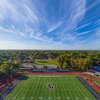
Opened in Cleveland as St. Ignatius College.
History Of John Carroll University
Founded in Cleveland in 1886 as St. Ignatius College, John Carroll University has grown across generations while remaining rooted in a Jesuit Catholic tradition of learning, service, and ethical leadership.
At A Glance
More Than A Century Of Growth
Five milestones provide immediate context for the University’s story.
Became John Carroll University.
Classes began on the present campus.
Women entered the University’s day program.
JCU graduates lead, serve, and make an impact across professions and communities.
From St. Ignatius College To JCU
A University Shaped By Place, People, And Purpose
John Carroll University began with the determination of Bishop Richard Gilmour and the Jesuits to establish a Catholic college for a growing Cleveland. St. Ignatius College opened on September 6, 1886, with 76 students and five Jesuit faculty members.
As the institution grew, its leaders prepared for a new era. The University adopted the John Carroll name in 1923, honoring the first Catholic bishop in the United States, and began a campaign to build a new campus in University Heights.
The cornerstone was laid in 1931. After construction resumed during the Great Depression, classes began beneath the Grasselli Clock Tower on October 7, 1935.
Across the decades that followed, JCU expanded its academic programs, facilities, student organizations, and relationship with Greater Cleveland. The University became coeducational in 1968 while its Jesuit Catholic mission remained an enduring foundation.
Key Moments In JCU History
From A Cleveland College To A National University
Explore defining moments in JCU’s academic, campus, and community history.
-
1876
The First Invitation
Bishop Richard Gilmour invites the Jesuits of the Buffalo Mission to establish a college in Cleveland.
-
1886
St. Ignatius College Opens
The College opens on September 6 with 76 students and five Jesuit faculty members.
-
1903
Alumni Association Formed
Graduates establish the organization that becomes the JCU National Alumni Association.
-
1923
A New Name
The institution becomes John Carroll University in honor of the first Catholic bishop in the United States.
-
1925
The Carroll News Begins
Students publish the first issue of the University newspaper.
-
1931
University Heights Cornerstone
The cornerstone for the new campus is laid on July 5.
-
1935
Classes Begin On The New Campus
Students begin classes in University Heights on October 7.
-
1943–45
Wartime Service
JCU hosts the United States Navy V-12 College Training Program.
-
1968
Coeducation Begins
Women enter the University’s day program and take on expanding roles in campus life.
-
1972
First Women Graduate
The first women graduate from JCU’s day program.
-
2003
New Academic And Athletic Facilities
The Dolan Science Center and Don Shula Stadium are dedicated.
-
2018
A New Era Of Leadership And Investment
The Boler School becomes the Boler College of Business, and Michael D. Johnson becomes JCU’s first lay president.
-
2026
The University’s 27th President
Carolyn Noll Sorg begins her tenure as president on June 1.
A History Written By Its People
From JCU To A Wider World
JCU’s history extends beyond buildings and milestones. Generations of alumni have carried the University’s commitments to leadership, service, and intellectual inquiry into public life, journalism, business, athletics, education, and countless other fields.
Tim Russert
The longtime moderator of NBC’s Meet the Press became one of the country’s most trusted voices in political journalism. JCU’s Department of Communication and an exclusive NBC fellowship continue his legacy.
Explore Tim Russert’s LegacyDon Shula
The winningest head coach in National Football League history led his teams to two Super Bowl championships and established an enduring tradition of JCU alumni working in professional football.
Explore The Don Shula ChairMary Rose Oakar
The Cleveland educator and public servant became the first Arab American woman elected to the United States Congress and represented Northeast Ohio for eight terms.
Read Her Congressional BiographyA Jesuit Mission Across Generations
An Enduring Foundation
From its founding by the Society of Jesus to the present day, JCU has connected intellectual development with reflection, ethical responsibility, service, and care for the whole person.
Intellectual Excellence
Rigorous learning that encourages curiosity, critical thought, and engagement across disciplines.
Care For The Whole Person
An educational community attentive to each person’s dignity, development, and potential.
Discernment And Leadership
Preparation to make thoughtful choices and lead with integrity, humility, and purpose.
Justice And Service
A commitment to use knowledge and ability in service of communities and the common good.
Explore JCU’s Archives
See The History, Not Just The Dates
Photographs, student publications, programs, and institutional records preserve the experiences of generations of Blue Streaks.
Building University Heights
Explore photographs documenting the development of JCU’s University Heights campus during the 1930s.
View The Construction CollectionThe Carroll News
Read student reporting, commentary, and campus coverage dating back to the newspaper’s first issues.
Browse The Carroll NewsCommencement Programs
Explore programs documenting graduates, speakers, ceremonies, and changing academic traditions.
Browse Commencement ProgramsCarroll Collected
Discover scholarship, University publications, archival photographs, yearbooks, and other digital collections.
Explore Carroll CollectedUniversity Leadership
Presidents Of John Carroll University
The University’s presidents have guided JCU across periods of growth, challenge, and change.
View The Complete List Of Presidents
- 1886–1888John B. Neustich, S.J.
- 1888–1893Henry Knappmeyer, S.J.
- 1893–1897Joseph P. LeHalle, S.J.
- 1897–1902Godfrey Schulte, S.J.
- 1902–1906John Zahm, S.J.
- 1906–1910George J. Pickel, S.J.
- 1910–1915John B. Furay, S.J.
- 1915–1919William B. Sommerhauser, S.J.
- 1919–1925Thomas J. Smith, S.J.
- 1925–1928Murtha J. Boylan, S.J.
- 1928–1937Benedict J. Rodman, S.J.
- 1937William M. Magee, S.J.
- 1937George J. Pickel, S.J.
- 1937–1942Edmund C. Horne, S.J.
- 1942–1946Thomas J. Donnelly, S.J.
- 1946–1956Frederick E. Welfle, S.J.
- 1956–1967Hugh E. Dunn, S.J.
- 1967–1970Joseph O. Schell, S.J.
- 1970–1980Henry F. Birkenhauer, S.J.
- 1980–1988Thomas P. O’Malley, S.J.
- 1988–1995Michael J. Lavelle, S.J.
- 1996–1998John J. Shea, S.J.
- 1998–2005Edward Glynn, S.J.
- 2005–2017Robert L. Niehoff, S.J.
- 2018–2021Michael D. Johnson, Ph.D.
- 2021–2026Alan R. Miciak, Ph.D.
- 2026–PresentCarolyn Noll Sorg